What this model family is
An Enterprise AI Built for Retrieval, Grounding, and Tool-Calling Workflows
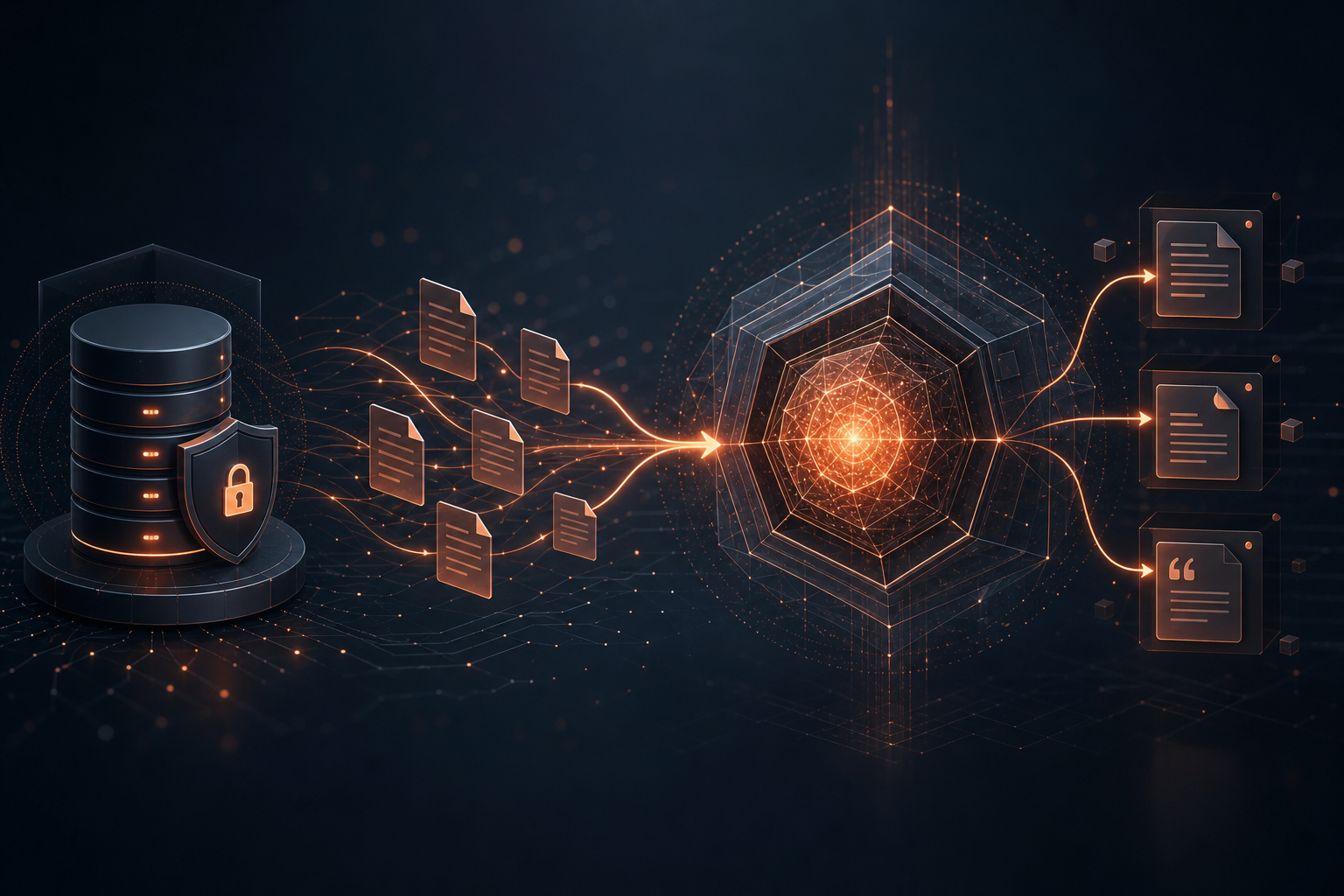
Command R is a family of open-weight models from Cohere built specifically for enterprise RAG workflows, retrieval-augmented generation, and agentic tool use. Unlike general-purpose chat models, Command R is designed to ground its answers in retrieved source documents, cite its sources explicitly, and make reliable tool calls in structured pipelines.
The family is available in two primary variants: Command R (35B) for efficient production RAG workloads, and Command R+ (104B) for the highest-quality retrieval and reasoning tasks. Both carry 128K context windows — enough to include large document collections in a single context without chunking.
NoCloudGPT will confirm current model availability, license terms, tags, and hardware fit before deployment begins. Cohere license terms (CC-BY-NC for some variants) before production deployment. License terms affect commercial use eligibility and should be reviewed carefully.
Who developed it
Cohere
Command R is developed by Cohere, a Toronto-based AI company focused on enterprise language AI. Cohere's research emphasis has been on retrieval, embeddings, and grounded generation — the technical foundation that makes Command R particularly strong for RAG workflows and structured document analysis.
Cohere releases Command R weights publicly for research and non-commercial use. NoCloudGPT will confirm current model availability, license terms, tags, and hardware fit before deployment begins. use conditions are subject to change and must be verified before production deployment. Some variants carry CC-BY-NC restrictions.
NoCloudGPT is an independent deployment service. We are not affiliated with, endorsed by, or partnered with Cohere. We help organizations run Command R on their own infrastructure using Ollama.
Why teams choose it
What Makes Command R Different for Enterprise Workflows
Grounded, citable answers from your documents
Command R is specifically trained to answer questions based on retrieved source documents and to cite which passage each answer comes from. For legal, compliance, and research teams that need auditable, source-linked answers — not hallucinated summaries — this is a meaningful practical difference.
Tool calling and agentic pipelines
Command R supports native tool calling — the ability to invoke database queries, APIs, and search functions as part of a multi-step workflow. For organizations building AI agents that retrieve, analyze, and act on internal data, Command R's tool-calling reliability is a production advantage over general-purpose models.
128K context for large document collections
The long context window means you can include multiple retrieved documents, conversation history, and system prompt in a single inference call — without the chunking complexity that causes RAG pipelines to lose cross-document context.
Private internal knowledge base search
Paired with a private embedding model and vector store, Command R becomes the reasoning layer of a fully private enterprise knowledge base. Staff ask natural-language questions; Command R retrieves and synthesizes answers from your internal documents — nothing routed through external APIs.
Who this model family is for
Who This Model Family is For
Command R (35B) is a strong option for users who want capable long-document reasoning and grounded answers without the heavy hardware requirements of Command R Plus. If you regularly work with lengthy PDFs, research reports, or internal documentation and want an AI that cites its sources and stays anchored to the material you provide, this model is worth considering. It is notably honest about uncertainty compared to many general-purpose models, which matters when using AI output for real decisions. It requires meaningful hardware to run well locally, so it is better suited to a dedicated workstation or home server than a laptop.
Command R's core strength is Retrieval-Augmented Generation (RAG). It is designed to take documents, internal knowledge bases, or retrieved content and produce grounded, cited responses. For teams that need AI to work with their own data rather than just general world knowledge, this is a meaningful advantage. It handles tool calling and multi-step agentic tasks reliably, making it practical for internal search assistants, document Q&A systems, and workflow automation where accuracy and traceability matter. It is the more accessible option in the Command R family — meaningfully lighter than Command R Plus while retaining strong RAG and tool-use capabilities.
Developers building RAG pipelines, enterprise search tools, or document-grounded chatbots will find Command R a practical deployment target when hardware budgets are constrained. Its tool-calling implementation follows Cohere's structured format cleanly and behaves predictably in agentic loops. The 128K context window allows you to pass substantial document chunks without aggressive chunking. Note that for pure code generation tasks, specialized models like Qwen 2.5 Coder generally outperform Command R. Its strengths lie in grounded language tasks and document reasoning rather than syntax-heavy code generation.
Researchers working with large text corpora — academic papers, legal documents, clinical notes, or policy files — will appreciate Command R's grounded generation behavior. It is less prone to fabricating citations or drifting from source material than many general-purpose models of similar size. The long context window makes it feasible to analyze lengthy documents that would otherwise need to be split across multiple calls with shorter-context models. It won't replace domain-specific fine-tuned models for specialized extraction tasks, but as a reasoning layer over retrieved documents, it remains one of the stronger open-weight options in its class.
Best-fit workloads
What to Use Command R For
Private RAG and internal knowledge bases
The backbone model for enterprise RAG systems. Retrieves answers from internal document collections, policies, and knowledge bases with source citations and minimal hallucination drift.
Contract and legal document Q&A
Lawyers and compliance teams feed contract collections into Command R and ask structured questions — with cited answers that trace back to the specific clauses that support each response.
Tool-calling agents and automation
AI agents that orchestrate multi-step processes — querying databases, calling internal APIs, reading policy files, and synthesizing results — benefit from Command R's reliable tool-calling behavior.
Research and intelligence synthesis
Analysts who need to synthesize large collections of source documents into structured reports, with cited passages that support each analytical conclusion.
Which size should you choose?
Command R vs Command R+
Command R (35B) — Professional AI
Practical defaultThe standard production RAG model. Handles most enterprise document Q&A, tool-calling pipelines, and retrieval workflows on professional GPU hardware. Requires approximately 20–24 GB VRAM at Q4. NoCloudGPT will confirm current model availability, license terms, tags, and hardware fit before deployment begins.
Command R+ (104B) — Enterprise AI
Maximum qualityThe flagship. Significantly stronger reasoning on complex multi-step retrieval tasks. Requires multi-GPU or on-premise hardware. Right for organizations where retrieval accuracy is mission-critical and hardware investment is justified. NoCloudGPT will confirm current model availability, license terms, tags, and hardware fit before deployment begins.
Honest guidance
When to Choose a Different Model Instead
Your use case is general chat, writing, or summarization
Command R is optimized for RAG and retrieval. For general business writing, Q&A, and daily assistant work, Llama or Qwen deliver better results at lower hardware cost. See Llama →
You need only embeddings, not a generative RAG layer
For private document search without a generative answer layer, a dedicated embedding model is more efficient and easier to deploy. See Nomic Embed →
License terms are a barrier for your use case
Confirm Command R's current license before commercial deployment. If commercial use is restricted, Llama 3.1 and Mistral Nemo offer strong RAG capability under clearer permissive licensing. See Mistral →
Licensing information
Licensing Information
Command R (35B) is released by Cohere under a restrictive commercial license, not a fully permissive open-source license.
Key points:
- Non-commercial use is generally permitted.
- Commercial use requires a separate agreement with Cohere.
- There is no simple "scale threshold" — commercial deployment typically requires direct licensing discussions with Cohere.
- The model may not be used to compete with Cohere's own products and services.
If you are evaluating Command R for any commercial or internal business use, you should contact Cohere directly before deploying.
Official model card:
Disclaimer: NoCloudGPT provides licensing information as a convenience summary only. License terms can change. Always review the official model card and consult qualified legal counsel before deploying in a commercial or regulated environment. NoCloudGPT is not responsible for licensing decisions made by customers.
Available model sizes
Available Model Sizes
| Model Size | Ollama Tag | Recommended NoCloudGPT Tier | Notes | |
|---|---|---|---|---|
| Command R 35B | command-r:35b |
Standard / Pro | Strong RAG and tool-use capabilities with significantly lower hardware requirements than Command R Plus. Non-commercial license by default — commercial use requires separate agreement with Cohere. | Get quote → |
Note: If your use case requires maximum reasoning depth and you have the infrastructure to support it, consider Command R Plus (104B) instead. It shares similar RAG strengths but demands substantially more hardware.
Deploy with NoCloudGPT
Start Your Private Command R Deployment
NoCloudGPT configures Command R on your GPU instance or on-premise server, installs Ollama and OpenWebUI, and helps you design your RAG pipeline architecture. We handle the infrastructure — your team focuses on the document collections and workflows that make the system useful.