What this model family is
Meta's Fourth-Generation Open AI — Natively Multimodal, MoE-Efficient, Long-Context
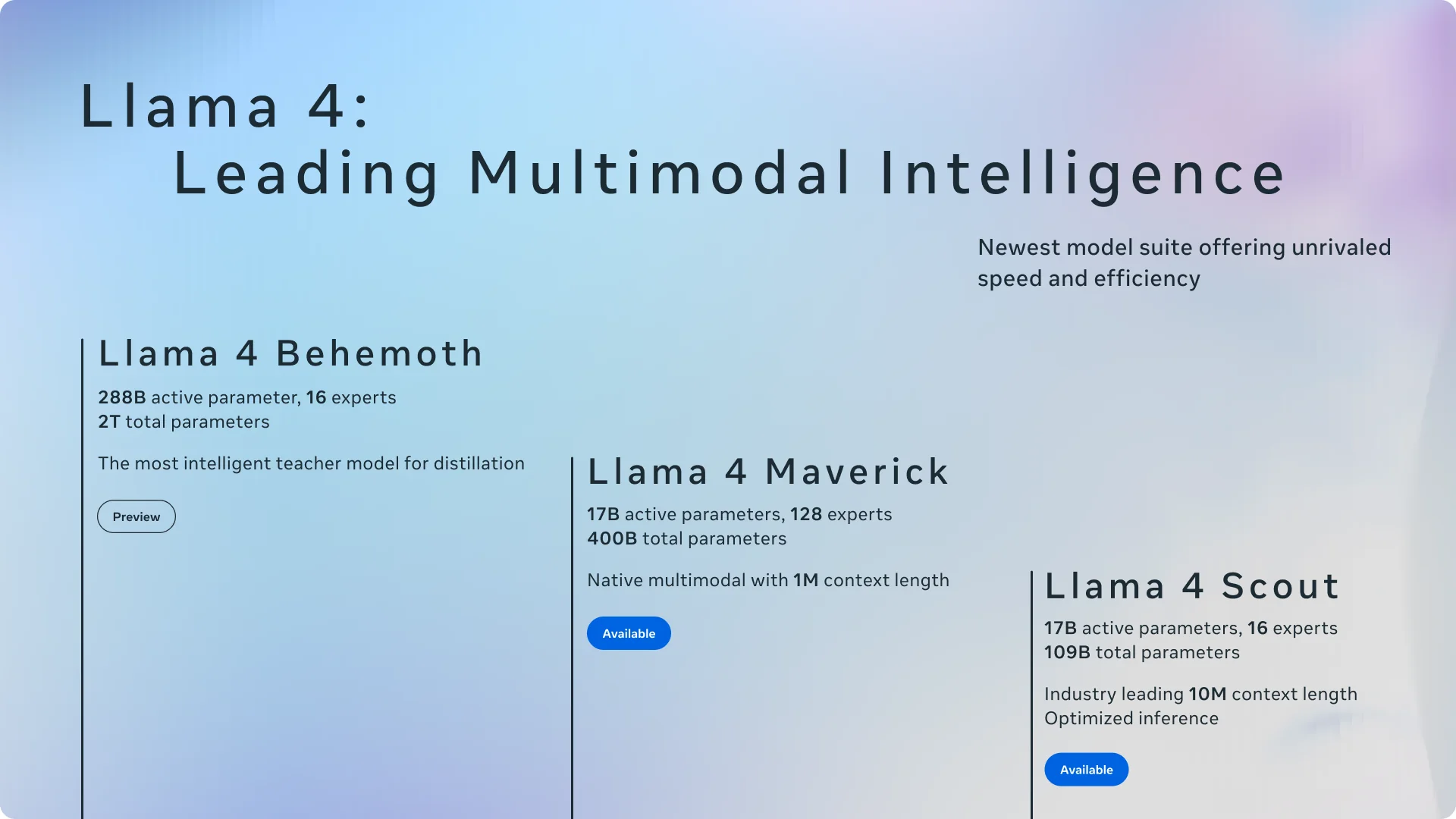
Llama 4 represents a significant architectural step from earlier Llama generations. Where Llama 3 was a dense transformer, Llama 4 adopts a Mixture-of-Experts design that activates only a fraction of its parameters per token — delivering better output quality at lower active compute cost. The Scout model brings a 10M+ token context window, meaning entire codebases, document libraries, or long research corpora fit in a single context without chunking.
Equally important: Llama 4 is natively multimodal. Both Scout and Maverick process images alongside text without requiring a separate vision model. Organizations that need AI to handle documents with embedded images, visual Q&A, or screenshot analysis can now do it from a single private Llama 4 deployment.
Llama 4 Scout
17B×16E MoE — The practical deployment
17B active parameters across a 16-expert MoE architecture. 10M token context window. Native vision. The recommended Llama 4 model for most private deployments — strong capability with more manageable hardware requirements than Maverick. NoCloudGPT will confirm current model availability, license terms, tags, and hardware fit before deployment begins.
Llama 4 Maverick
17B×128E MoE — High-capability flagship
17B active parameters across 128 experts — significantly larger total parameter count with the same active compute efficiency. Competitive with frontier commercial models on complex reasoning tasks. Requires substantial hardware. NoCloudGPT will confirm current model availability, license terms, tags, and hardware fit before deployment begins.
Who developed it
Meta AI Research
Llama 4 was released by Meta AI Research in April 2025 as the fourth generation of Meta's open-weight model series. Meta AI is the AI research division of Meta Platforms, and the Llama series has become the most widely deployed open-weight model lineage across research, production, and private deployment globally.
NoCloudGPT will confirm current model availability, license terms, tags, and hardware fit before deployment begins.Earlier Llama generations used a custom community license with commercial restrictions above certain user thresholds. Llama 4 license terms should be reviewed before production deployment.
NoCloudGPT is an independent deployment service and is not affiliated with Meta AI.
Why teams choose it
What Makes Llama 4 the Right Choice for Private Deployment
Native vision without a second deployment
Llama 4's built-in vision capability means one deployment handles both text and images. Documents with embedded charts, screenshots, scanned forms, and visual diagrams are processed privately in a single inference call.
Frontier-competitive quality, private by default
Organizations that previously needed GPT-4o or Claude for demanding reasoning tasks now have a comparable open-weight option that runs on infrastructure they control. No prompts, documents, or images leave your server.
10M token context window (Scout)
Scout's 10M token context is orders of magnitude beyond previous Llama generations. Entire codebases, research libraries, or year-long document collections can be analyzed in a single context — eliminating the chunking complexity that causes AI pipelines to lose cross-document reference.
MoE efficiency — more capability per GPU hour
The Mixture-of-Experts design means Llama 4 delivers significantly more capability than a dense model of equivalent active parameter count. On-premise GPU investments go further with Llama 4 than with equivalent-quality dense alternatives.
Who this model family is for
Who This Model Family is For
Llama 4 is a strong pick if you want a capable home assistant that handles long documents, multi-step questions, and image understanding without sending anything to a cloud provider. The smaller Scout variant runs comfortably on a single high-end consumer GPU or a well-equipped workstation, making it realistic for hobbyists who already own decent hardware. Be aware that Llama 4 is a mixture-of-experts architecture, so RAM and VRAM requirements are higher than the parameter count alone suggests — you're loading all experts even if only some activate per token.
For small and mid-sized teams, Llama 4 Scout offers a practical balance: native multimodal input, a very long context window (useful for contracts, transcripts, and internal knowledge bases), and competitive instruction-following without the per-token costs of hosted APIs. Maverick is a better fit for organizations that need stronger reasoning across customer support automation, internal copilots, or document-heavy workflows. Keep in mind the Llama 4 Community License has commercial restrictions for very large companies (see below), which may affect enterprise buyers.
Llama 4 is well-suited for building RAG systems, agentic workflows, and code-assist tools where long-context recall actually matters — Scout's 10M token context is genuinely useful for whole-repo analysis, though effective recall at the extremes is still an open question. Native image input simplifies multimodal pipelines that previously required separate vision models. Tool-calling and structured output work reliably, but expect to spend time on prompt engineering and evals; Llama 4 is less polished out-of-the-box than closed frontier models.
Researchers get an openly available MoE model with transparent weights, making it a rare option for studying expert routing, long-context behavior, and multimodal alignment at scale. Llama 4 is a reasonable baseline for fine-tuning experiments, distillation work, and comparative benchmarking against Llama 3, Mistral, and Qwen families. Limitations: training data details remain partial, and the largest Behemoth variant has not been released as open weights, which restricts certain reproducibility studies.
Best-fit workloads
What to Use Llama 4 For
Document analysis with images and text
Legal filings with embedded tables, financial reports with charts, engineering drawings alongside specs — Llama 4 processes the full document in one pass without external vision services.
Long-document research and synthesis
Scout's 10M context enables analysis across entire document collections — regulatory archives, research corpora, or multi-year correspondence — in a single private inference session.
Complex reasoning and professional writing
Demanding analytical tasks — multi-step problem decomposition, competitive intelligence, legal reasoning, financial analysis — where previous open-weight generations showed clear limits.
Code generation and technical work
Repository-scale code analysis, architecture-level review, and sophisticated code generation where proprietary source code cannot leave internal infrastructure.
Which size should you choose?
Scout or Maverick — Choosing Your Llama 4 Deployment
Llama 4 Scout — Professional AI
Practical defaultThe recommended starting point for most Llama 4 deployments. 17B active parameters, 10M token context, native vision. Requires GPU hardware — plan for 20+ GB VRAM at practical quantization. NoCloudGPT will confirm current model availability, license terms, tags, and hardware fit before deployment begins. current Ollama tags before deployment planning.
Llama 4 Maverick — Enterprise AI
Frontier quality128 experts with 17B active — frontier-competitive quality. Requires substantial GPU infrastructure. Right for organizations where output quality is non-negotiable and the hardware investment is justified. Plan a full hardware conversation before committing to Maverick. NoCloudGPT will confirm current model availability, license terms, tags, and hardware fit before deployment begins.
Honest guidance
When to Choose a Different Model Instead
You need the most efficient option for modest hardware
Llama 4 requires GPU hardware. For small cloud instances or CPU-only servers, Llama 3.1 8B or Qwen 4B still deliver strong everyday quality. See Llama 3.x →
Your workload is pure chain-of-thought reasoning
For compliance review and auditable reasoning, DeepSeek R1's explicit chain-of-thought output may be a better fit than Llama 4's general reasoning. See DeepSeek R1 →
Licensing information
Licensing Information
Llama 4 is released under the Llama 4 Community License Agreement, an open-weights license with specific restrictions. Key points:
- Free for most commercial and personal use, including fine-tuning and derivative models.
- Acceptable Use Policy applies (no use for weapons, CSAM, mass surveillance, etc.).
- 700M monthly active user threshold: companies whose products exceeded 700M MAU as of the Llama 4 release date must request a separate license from Meta.
- Attribution required: derivative models must include "Llama" in their name and display "Built with Llama."
- EU restriction: at release, Meta's license restricted multimodal model use for entities domiciled in the EU. Confirm current status before deploying in that region.
Official model cards:
Disclaimer: Licensing terms change. Always verify the current license directly on the official Hugging Face model card before deploying commercially. NoCloudGPT does not provide legal advice.
Available model sizes
Available Model Sizes
| Model Size | Ollama Tag | Recommended NoCloudGPT Tier | Notes | |
|---|---|---|---|---|
| Llama 4 Scout (17B active / 109B total, 16 experts) | llama4:scout |
Workstation / Pro GPU | Multimodal, 10M context window, fits on a single H100 (or quantized on 1× 80GB GPU). Best general-purpose pick. | Get quote → |
| Llama 4 Maverick (17B active / 400B total, 128 experts) | llama4:maverick |
Multi-GPU Server | Stronger reasoning and coding than Scout; requires significant VRAM (multi-GPU H100/H200 or quantized on 1× node). | Get quote → |
| Llama 4 Behemoth (288B active / ~2T total) | Not released as open weights | N/A (not deployable) | Meta's teacher model. Used internally for distillation; no public weights available at this time. | — |
Llama 4's MoE design means total parameters dictate memory, but active parameters dictate inference speed. Scout is dramatically cheaper to run than its 109B total parameter count implies — closer to a dense 17B in throughput, but with much higher memory needs. Sizing matters; request a quote and we'll match the model to your actual hardware budget.
Deploy with NoCloudGPT
Start Your Private Llama 4 Deployment
Llama 4 deployments require a hardware conversation before the pilot begins. NoCloudGPT will help you evaluate Scout vs Maverick, confirm current hardware requirements, and configure Ollama and OpenWebUI with vision support enabled for your use case.