What Is MiniMax?
MiniMax is a Shanghai-based AI company that has released a series of high-capability foundation models competitive with leading international labs. Their models are notable for combining very long context windows — up to 1 million tokens in the M1 series — with strong instruction-following, tool use, and multimodal understanding.
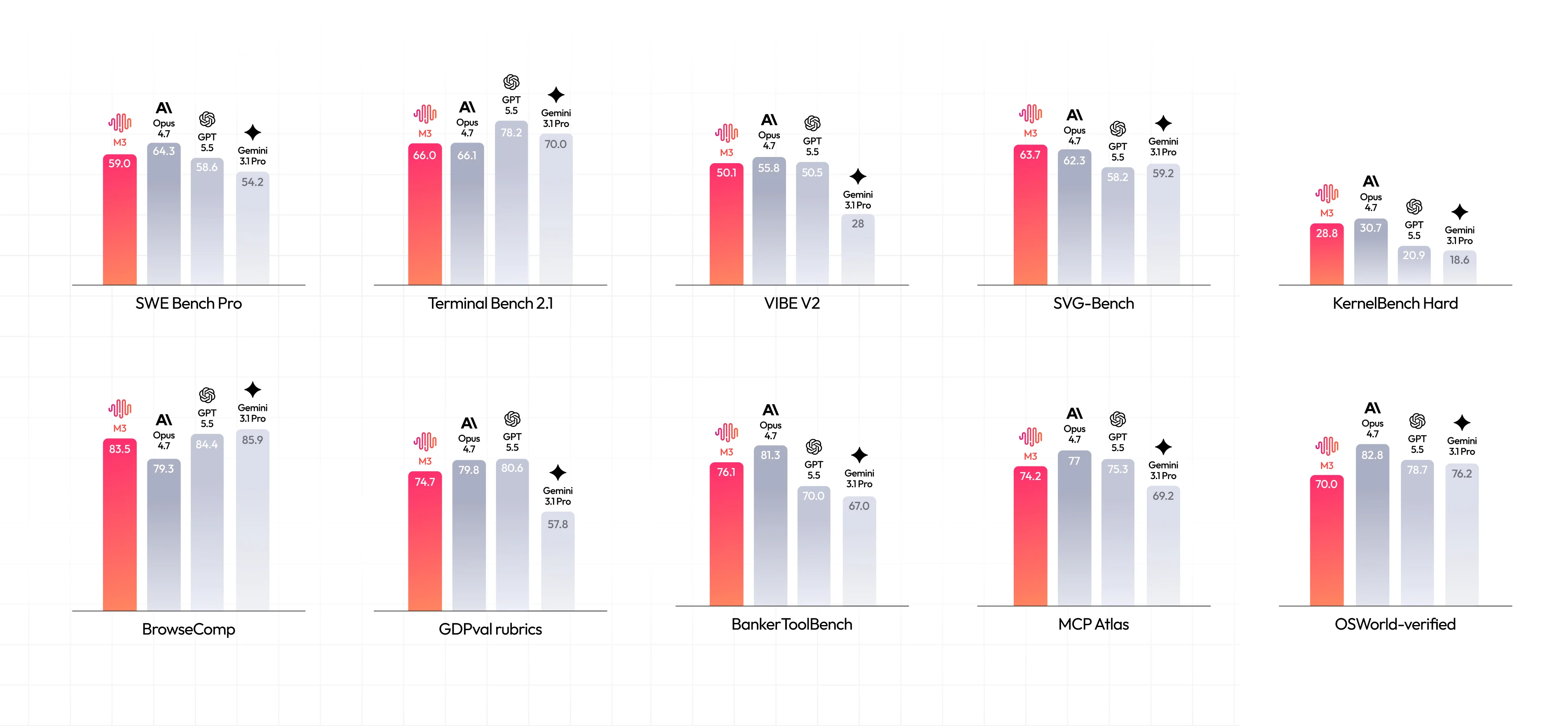
The flagship MiniMax M1 is a mixture-of-experts model with 456 billion total parameters and 45.9 billion active parameters per forward pass. It was released in mid-2025 and benchmarks favourably against GPT-4o and Claude 3.5 Sonnet on long-document tasks, multi-step reasoning, and agentic tool-calling scenarios. The model uses a hybrid attention architecture that combines softmax attention for precision with lightning attention for linear-scaling throughput at extreme context lengths.
For organisations handling contracts, research corpora, clinical records, or large codebases, MiniMax M1 offers the ability to reason across an entire document set in a single context window — a capability that eliminates the need for chunking pipelines or external retrieval systems in many use cases.
Model Strengths
1M Token Context Window
MiniMax M1 supports up to one million tokens of context — equivalent to roughly 750,000 words or several full-length books. This enables whole-document reasoning, cross-file code analysis, and long-form synthesis without retrieval middleware.
Agentic Tool Use
M1 is trained for multi-step agentic workflows. It can plan, call tools, evaluate results, and iterate — making it suitable for autonomous research agents, coding assistants, and process automation systems that require sustained reasoning chains.
Mixture-of-Experts Efficiency
With 456B total parameters but only ~46B active per token, M1 delivers frontier-level output quality at a fraction of the compute cost of equivalent dense models. This makes large-scale private deployment more economically viable.
Multimodal Input
MiniMax models support image and document inputs alongside text, enabling workflows that mix visual and textual data — including chart analysis, scanned document processing, and mixed-media report generation.
Strong Multilingual Performance
Trained on diverse multilingual corpora with particular strength in Chinese and English, MiniMax models are well-suited for organisations operating across Asian and Western markets or handling multilingual document sets.
Open Weights
MiniMax M1 weights are publicly available, enabling fully private on-premise deployment with no dependency on MiniMax's API infrastructure. Your data stays on your hardware, under your control.
Who Should Deploy MiniMax?
MiniMax M1 is best suited for organisations where context length is a limiting factor in current AI deployments. If your workflows involve large documents, multi-file codebases, or long conversation histories that exceed what GPT-4o or Claude can handle in a single pass, M1 removes that constraint entirely.
- Legal and compliance teams processing full contracts, case files, or regulatory submissions in a single context window
- Financial analysts working across earnings transcripts, SEC filings, and research reports simultaneously
- Healthcare and clinical research organisations analysing long patient records, trial protocols, or literature corpora
- Software engineering teams that need whole-repository code understanding for refactoring, documentation, or security audits
- Intelligence and research organisations synthesising large document corpora with complex cross-reference requirements
- Enterprises with multilingual operations needing strong Chinese-English bilingual capability in a self-hosted environment
Hardware Requirements
MiniMax M1 is a large MoE model that requires substantial GPU infrastructure for full-precision deployment. Quantised variants reduce memory requirements significantly while preserving most of the model's capability.
| Configuration | VRAM Required | Recommended Hardware | Best For |
|---|---|---|---|
| M1 Q4 (quantised) | ~120GB | 2× H100 80GB or 4× A100 40GB | Cost-effective private deployment |
| M1 Q8 (quantised) | ~200GB | 4× A100 80GB or 3× H100 80GB | High-fidelity inference |
| M1 Full Precision | ~400GB+ | 8× H100 80GB or H100 NVL cluster | Maximum capability, fine-tuning |
NoCloudGPT provisions and configures multi-GPU infrastructure for MiniMax M1 deployment. Contact us for a hardware sizing consultation tailored to your context length and throughput requirements.
Deployment Options
Managed GPU Cloud
NoCloudGPT deploys MiniMax M1 on dedicated multi-GPU instances with Ollama or vLLM serving. Includes monitoring, updates, and OpenAI-compatible API endpoint.
On-Premise Installation
Full hardware provisioning, network configuration, and model deployment on your own servers. Suitable for air-gapped environments and maximum data sovereignty requirements.
Hybrid Architecture
Combine MiniMax M1 with smaller edge models for tiered inference — routing simple queries to lightweight models and complex long-context tasks to M1 to optimise cost and latency.
Deploy MiniMax M1 Privately
One million token context. Full data sovereignty. No API dependency. Contact NoCloudGPT to scope your MiniMax M1 deployment.